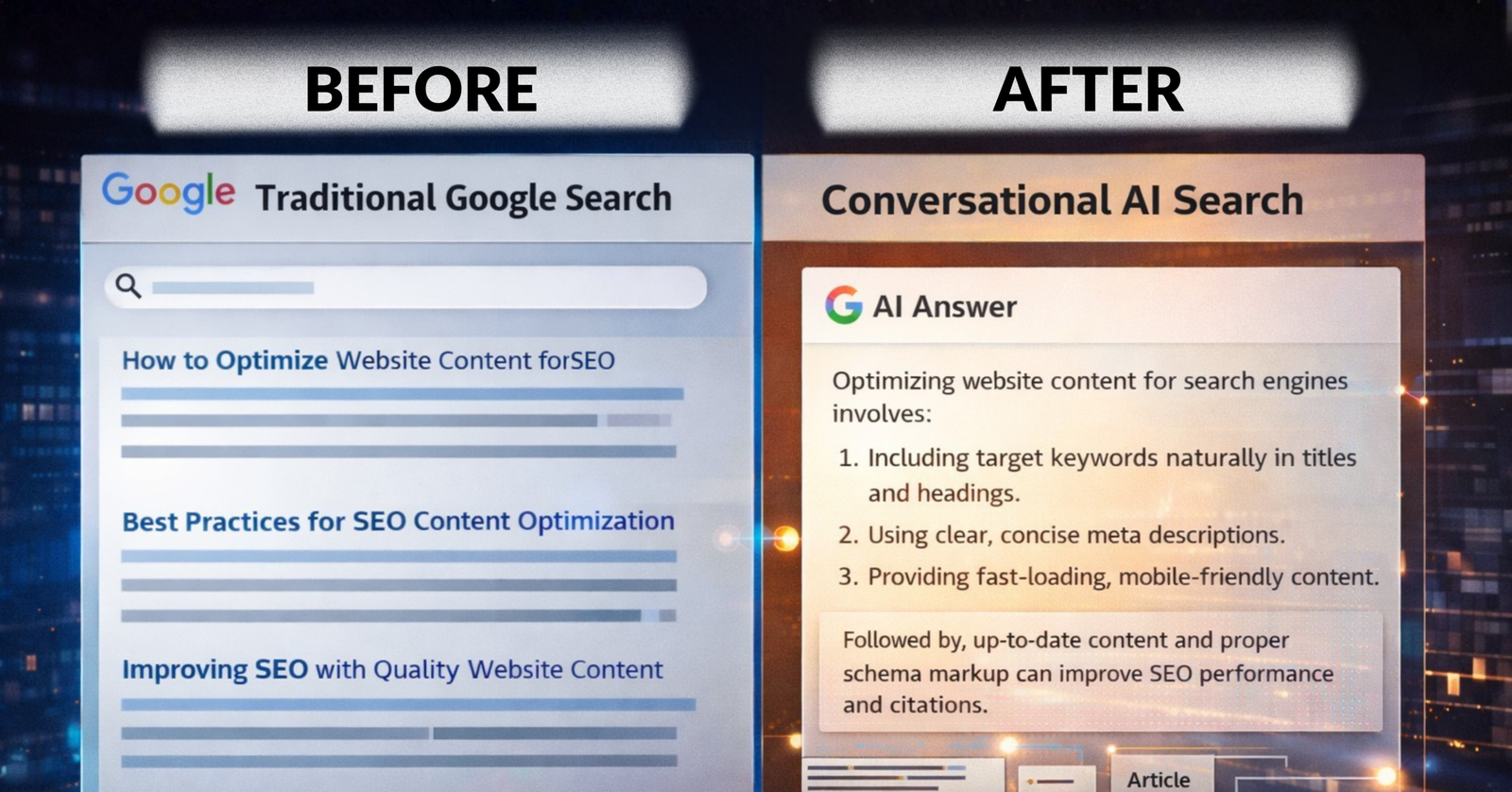
AI Search Optimization: How Brands Win Visibility in the AI Era
AI search has quietly rewritten the rules of online visibility. Brands that once ranked comfortably on page one of Google are now watching their traffic flatten—even as their content output increases. Meanwhile, other brands seem to appear everywhere: in ChatGPT answers, Google AI Mode summaries, and conversational search results.
This isn’t accidental. Instead it’s structural.
Large Language Models don’t retrieve content the way traditional search engines do. They don’t “scroll” pages or value long introductions. They extract, synthesize, and cite information based on confidence, structure, speed, and clarity. If your content isn’t built for that retrieval process, it simply doesn’t exist in AI search—no matter how good it sounds to human readers.
The good news, however, AI visibility is not about producing more content. Instead, it’s about producing structured, decisive, machine-readable answers and conversion-optimized content without losing human credibility.
In this guide, we break down how AI search optimization actually works in 2026, why most websites fail at it, and how brands can realign their content strategy to stay visible as search becomes increasingly conversational.
How AI Search Engines Retrieve and Use Content
Traditional SEO rewarded relevance and backlinks. By contrast, AI search rewards extractability.
Models like ChatGPT, Gemini, and Perplexity build responses by pulling from:
- Page titles and meta descriptions
- The first few paragraphs of content
- Clearly structured lists and tables
- Pages with fast server responses and stable indexing
If your most important answers live deep inside the page, the model never sees them.
AI systems typically evaluate:
- Can this page answer the question clearly?
- Is the information structured or scattered?
- Does the content repeat itself or contradict itself?
- Is the source fast, accessible, and indexed reliably?
If the answer to any of these is “no,” the content is skipped—regardless of how authoritative the brand may be.
The 30% Rule: Why the Top of Your Page Matters Most
One of the highest-leverage shifts in AI search optimization is front-loading value.
LLMs often build their entire response from:
- The headline
- The meta description
- The first 20–30% of the page
That means your introduction is no longer just a hook—instead it’s the primary extraction zone.
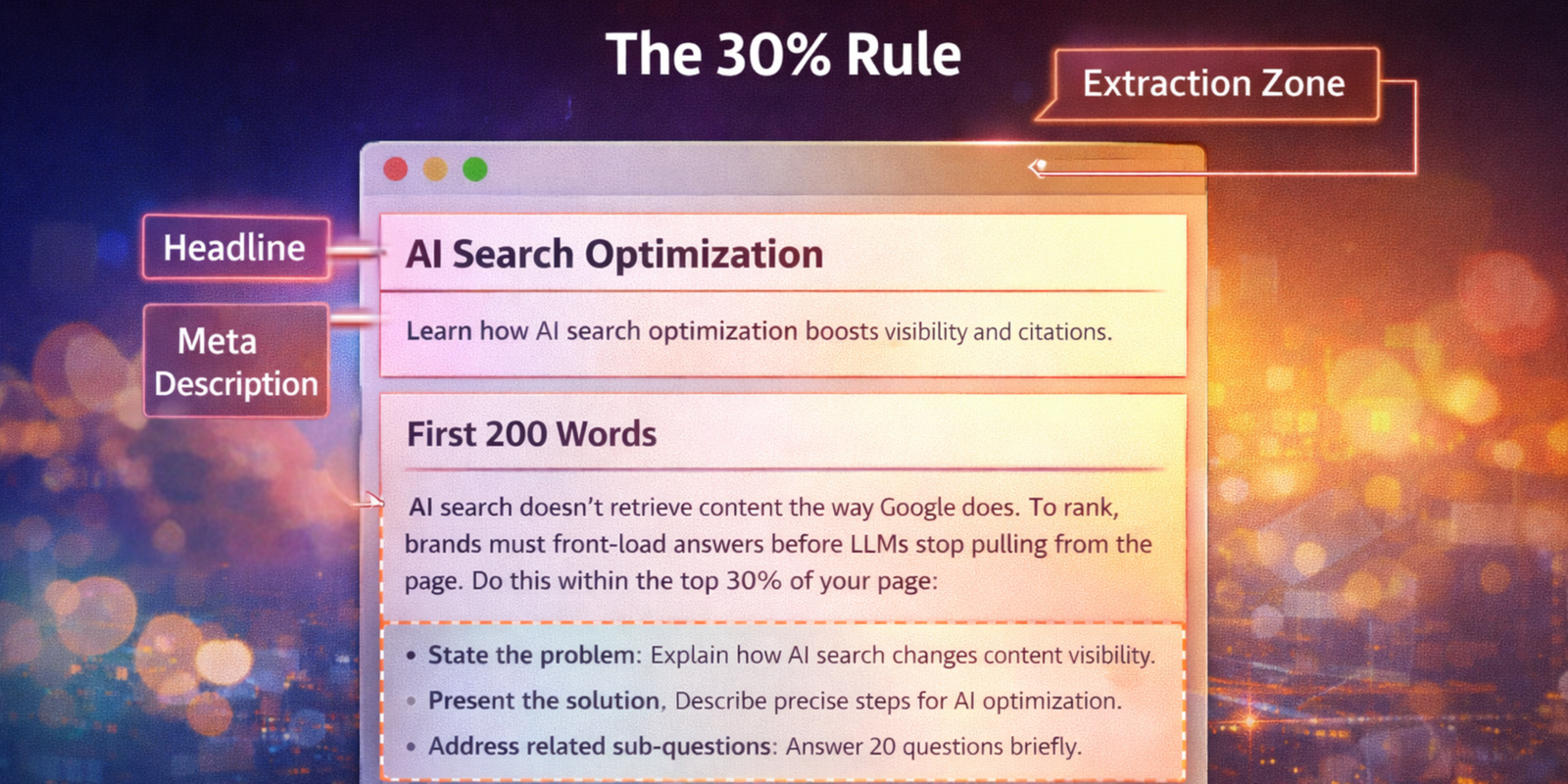
Effective AI-optimized pages now:
- Answer core questions immediately
- Avoid storytelling delays at the top
- Clearly define the topic in direct language
A strong top section should:
- State the problem
- Present the solution
- Address related sub-questions briefly
- Do all of this within 150–300 words
This alone puts a page ahead of most competitors.
Why Structured Content Wins in AI Search
AI models prefer content that is already synthesized.
Unstructured paragraphs force the model to interpret. Lists, tables, and comparisons allow it to extract with confidence.
High-performing AI-visible content relies on:
- Numbered frameworks
- Clear comparisons
- Single-purpose sections
- Predictable formatting
For example, instead of explaining a concept across five narrative paragraphs, structured content breaks it into:
- What it is
- Why it matters
- How it works
- Common mistakes
- Practical steps
This reduces ambiguity and increases citation probability.
One Idea per Paragraph: A Hidden Ranking Factor
Human readers can follow mixed ideas. However, LLMs cannot.
When a paragraph contains multiple ideas—definitions, opinions, examples, and outcomes—the model struggles to determine what the paragraph represents. Consequently, semantic confidence declines.
AI-friendly content follows a strict rule:
- One idea per paragraph
- 2–3 sentences maximum
- No topic switching mid-paragraph
This creates stable “content chunks” that AI systems can safely quote or summarize.
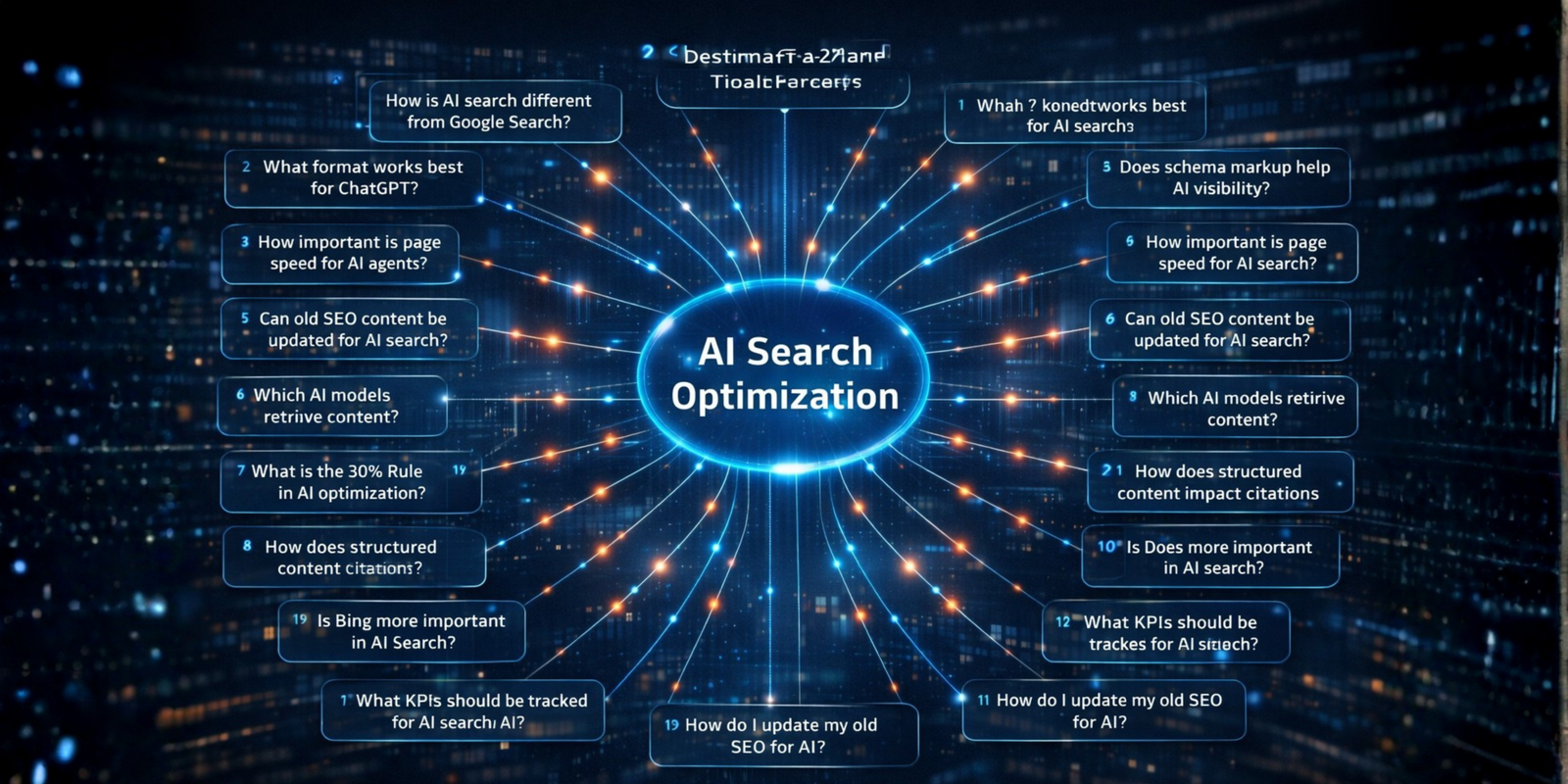
The 20-Question Fan-Out Strategy
The most visible AI pages don’t just answer one question. They answer every related question in one place.
A 20-question fan-out involves:
- Identifying 20–30 sub-questions a user might ask
- Answering them clearly within the same page
- Avoiding repetition or rephrasing the same answer twice
Examples of fan-out questions for AI search optimization:
- How is AI search different from Google Search?
- What content format works best for ChatGPT?
- Does schema markup help AI visibility?
- How important is page speed for AI agents?
- Can old SEO content be updated for AI search?
When all related answers exist on one page, the model treats it as a single source of truth.
Why Redundancy Hurts AI Visibility
Traditional SEO encouraged repeating ideas using synonyms. By contrast, AI search penalizes that.
When the same question is answered twice in different wording:
- The model sees competing chunks
- Semantic certainty drops
- Citation likelihood decreases
AI prefers:
- One definitive answer
- Clear positioning
- Minimal hedging
This doesn’t mean shorter content—it means cleaner content.
Page Speed and Indexing: The Technical Layer Most Brands Ignore
AI agents don’t wait.
If your site’s Time to First Byte exceeds one second, many AI crawlers time out. When that happens:
- Content isn’t retrieved
- Citations never occur
- Visibility drops silently
Because of this, key technical requirements for AI search optimization:
- Fast server-side rendering
- Clean HTML output
- Minimal JavaScript dependency
- Reliable uptime
- Optimized hosting environment
Equally important is indexing. ChatGPT and Perplexity rely heavily on Bing’s index, not just Google’s.
Therefore, brands that skip Bing Webmaster Tools often disappear from AI search without realizing why.
Why Generic SEO Content No Longer Works
AI systems actively downweight generic advice.
Phrases like:
- “In today’s digital world”
- “Content is king”
- “High-quality content matters”
…signal low informational value.
Instead, AI prefers:
- Specific steps
- Clear trade-offs
- Numbers and thresholds
- Real operational insights
For instance, saying “optimize page speed” is weak. By comparison, saying “keep TTFB under 1 second to avoid AI crawler timeouts” is extractable.
Schema and Clean Rendering: The Final Advantage Layer
Schema markup doesn’t guarantee AI citations. However, it removes friction.
When combined with:
- FAQ schema
- Article schema
- Clear headings
- Server-side rendering

…it helps AI systems understand:
- What the page is about
- Which sections answer which questions
- How content elements relate
As a result, brands that combine structured content with schema consistently outperform those relying on text alone.
The Three Changes That Deliver the Biggest Impact
If brands implement only three changes, these deliver the highest return:
- Create a top section that answers all fan-out questions in 150–300 words
- Convert the rest of the content into clean lists, tables, and focused sections
- Combine fast server-side rendering with basic schema markup
These alone place a website ahead of most competitors in AI visibility.
The Future of AI Search Visibility
AI search optimization isn’t about gaming algorithms. Rather, it’s about being useful in a machine-readable way.
As search shifts from links to answers:
- Clarity beats creativity
- Structure beats volume
- Speed beats aesthetics
Consequently, brands that adapt early will not just survive the AI transition—they’ll compound visibility while others chase declining traffic.
In short, the direction is clear. The only question is how quickly businesses choose to align with it.
Conclusion: Building for AI Without Losing the Human Touch
AI search has changed how content is discovered. However, it hasn’t changed why people search. Users still want clarity, accuracy, and trustworthy answers. The difference now is that AI now acts as the intermediary.
Therefore, winning in AI search optimization requires a mindset shift:
- From ranking to retrieval
- From keywords to questions
- From storytelling first to answers first
When content is structured for machines but written for humans, it earns the best of both worlds—visibility and credibility.
For brands navigating this shift, the opportunity is still wide open. Those who build with AI retrieval in mind today will define search leadership tomorrow.
If you want to explore deeper frameworks around AI-ready content, technical SEO, and future-proof visibility strategies, EDM Digital frequently publishes insight-driven resources designed for the evolving search landscape.